Thursday, May 5, 2011

Seeds of Sustainability

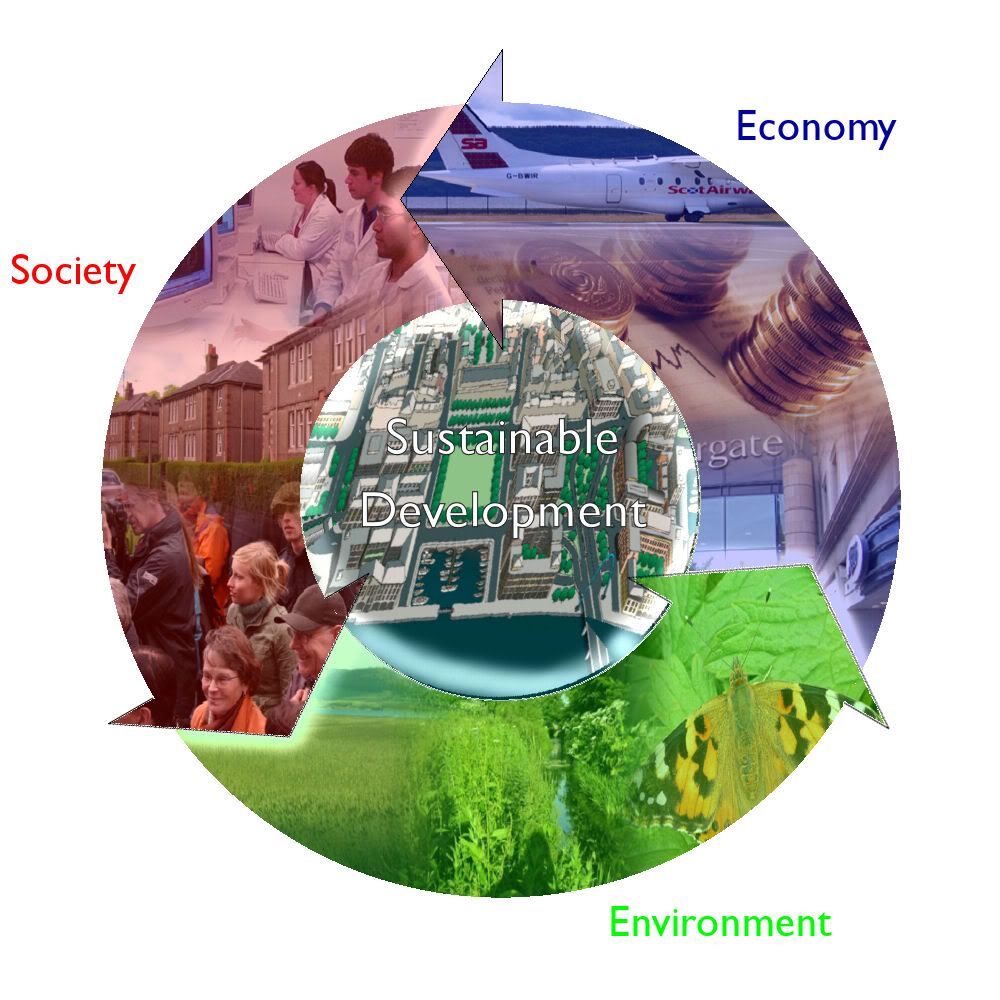
The term “sustainability” encompasses a complex array of ideas and perspectives. On a whole, it involves management and maintenance of the environment, the economy, and society. That can include reducing the amount of fossil fuels and raw materials we use, reducing the amount of food and water we consume, and reducing the amount of waste we produce without jeopardizing the livelihoods and economic stability of our society.

Yet while we think of achieving sustainability on an individual and organizational level, e.g. local towns, individual businesses, and social groups, at least for me, I never thought of how a bank could strive for sustainability (beyond their efforts to switch to e-statements).

And then I learned about the Unified Field Corporation (UFC).

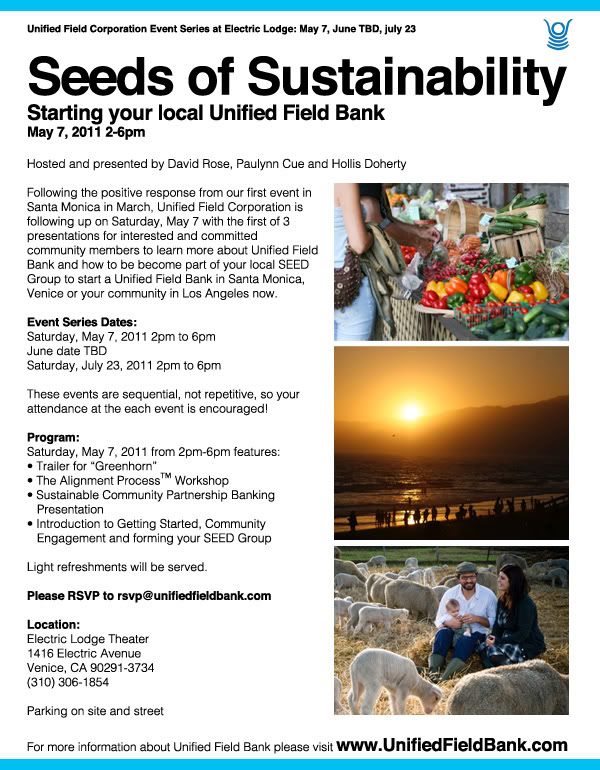
The Unified Field Corporation is a sustainable community partnership bank formation systems and development company with the vision to open Unified Field Banks across the nation. They maintain a quadruple bottom line- Financial Prosperity, Environmental Sustainability, Social Progress, and Preservation of Culture- and are an entirely different body of bank. They are redefining what it means to be a financial institution and are working right now on finding communities interested in becoming a part of the Unified Field Bank system.

On Saturday, May 7, 2011, the UFC will be coming to Venice, CA to begin a three-part event series to present information about Unified Field Banks and show interested community members how to start their very own Unified Field Bank in their local community. They are looking for team members, community engagers, and members interested in investing in their local bank and UFC. Please show your support and attend this wonderful series! This first event will take place from 2pm until 6pm at the Electric Lodge Theater (1416 Electric Avenue, Venice, CA 90291). Click here to view their flyer.
Friday, March 18, 2011

Green Jobs: Get to Work!

In today’s economy I feel that networking and collaboration have become two integral parts of business and key components to success. The Sustainable Business Council (SBC), a non-profit organization in Los Angeles founded by a group of sustainable business executives, and Pepperdine University’s Graziadio School of Business and Management are presenting a wonderful business event next week titled: “Green Jobs, Get to Work!” that works to facilitate those very two things.

The event, taking place at Pepperdine University next Wednesday, March 23rd, is open for any interested! Parking and attendance costs are complimentary, although there is a $25.00 suggested donation. The event will run from 7:00pm until 9:30pm and features a green internship fair and a panel discussion with executives from sustainable businesses such as Phoenix Energy Technologies and Belkin International, Inc.

Please come check it out! Whether you are a student seeking a potential internship with an eco-minded business or a business looking for new partnerships and advice, this event is sure to be a great venue to reach out and network with various minds in the green business community. The full details and Event Registration can be found here: http://www.sustainablebc.org/events.html.

Tuesday, January 18, 2011

Some eco-friendly resolutions

It may be too late to be writing about New Year’s resolutions, but I’m a firm believer in making commitments to improvements regardless of whether it falls exactly on a holiday or certain date. So, even if you have already made your resolutions (and maybe broken them…) or if you haven't made any, here are some simple lifestyle changes you can try to incorporate in your everyday life.

A few eco-friendly resolution ideas:

  • Only purchase reused or recycled clothing

Benefits: It prevents wonderful clothing items from being tossed in the landfill, conserves energy/material/time/costs to make new products, and saves you money. One of my friends made this exact resolution last year and it was such a success she is repeating it for 2011!

  • Bring reusable bags to ALL shopping trips

Benefits: They prevent plastic (produced from oil and a great input of energy) from being in landfills/streets/trees/oceans, they are more durable (no more double-bagging) than plastic bags so you can feel safer carrying heavy items, and they are often larger than the plastic bags, allowing you to fit more in fewer bags. Plus, as mentioned in my previous blog post, this may be a change you’ll be forced to make in Los Angeles come this July. Might as well get into a good habit!

  • Become a vegetarian

Benefits: Becoming vegetarian is one of the most important and effective actions you can take to reduce the negative impact you have on the environment. Livestock production accounts for 18% of global greenhouse gas emissions, generates an enormous amount of water pollution in the form of pesticides, antibiotics, and fecal matter, and requires an enormous amount of land, water, grain, and petroleum. In fact, researchers at the University of Chicago concluded that switching from a standard American diet to a vegan diet is more effective in the fight against climate change than switching from a standard American car to a hybrid. To find out more, check out this article: “7 Clear-Cut Reasons Why Meat is Bad for the Environment

  • Designate a box or bag for electronic recycling (batteries, cell phones, printers, computers)

Benefits: Having a box or bag set aside specifically for electronics to be recycled will help encourage and remind you to keep hazardous material out of landfills/groundwater and allow for those items to be reused. I know how hard it can be to hold on to used batteries instead of just tossing them in the trash, but if there is a bag already labeled for e-waste, it can help keep those tiny pieces together. Then, at the end of the year, you can stop by at a HHW/E-Waste Collection Event or one of LA’s S.A.F.E Centers

  • Make all mailings electronic (billing, magazines, newspapers, letters to friends, ask to be placed off of mailing lists)

Benefits: At least for me, electronic mailings are easier for me to track, categorize, and find than regular mail. They also save on paper, reduce postage costs, and prevent clutter. Check out http://www.catalogchoice.org/ to get yourself off of all those unsolicited mailings.

  • Stop drinking bottled water

Benefits: It’s healthier and cheaper for you and helps the environment. Read to find out more: "5 Reasons Not to Drink Bottled Water"

Thursday, December 23, 2010

California leading the cap-and-trade movement

Last Thursday the California Air Resources Board, with a 9-to-1 approval, voted in a critical piece of AB32 (the climate change law set to reduce emissions to 1990 levels by 2020). Beginning in 2012, the nation’s most comprehensive carbon trading program will take effect in California.

This program will incentivize, through allowances and credit/offset purchases, businesses and factories to curb their emissions of carbon dioxide and other heat-trapping gases. Each allowance represents one ton of greenhouse gas emissions. The allowances will be mostly free for the first three years with the allowed emissions level declining annually.

When it comes into effect, companies over the allowed levels will either have to reduce their emissions or buy credits from other businesses to cover their excess. With a huge incentive to invest in clean technology, companies seeking reduction in emissions will be turning to green tech businesses to help shift their current emission levels. Also, green businesses already below the levels will be able to sell their credit to other companies and earn a profit.

Although it is too early to truly tell, this major change sounds like a great boost for green businesses everywhere and will hopefully spur economic recovery.


To learn more, check out the LA Times article: http://articles.latimes.com/2010/dec/17/local/la-me-1217-climate-cap-trade-20101217

or the NPR article: http://www.npr.org/templates/story/story.php?storyId=132100915